Today exactly 35 years ago, my dear friend Stefan Posthuma and myself were witness to synth virtuoso Vangelis performing ‘live’ in Rotterdam. Back then, we created a so-called real-time article about these events, which is featured below (in more or less its original and sometimes perhaps slightly infantile form – hey, we were around 20+ back then!). If you can’t follow the many in-jokes, don’t feel guilty… just like I don’t feel guilty about spelling/grammar mistakes that I made but might have missed when editing my below stream-of-consciousness blathering.
Here goes… Like Samuel L. Jackson would say in “Jurassic Park” (years after everything below happened): “Hold on to your butts!”
Around April (1990), an interesting rumour went round: The Greek synthesizer virtuoso Vangelis was supposed to be performing live at the Maasvlakte in Rotterdam, The Netherlands.
To mere mortals like myself this was of course a delight of cosmic proportions. Stefan and me had been unable to buy tickets for Jean Michel Jarre’s “Docklands” concert. I had driven past Paris on July 14th 1990, completely unaware of Jarre’s performance there that evening. After two of these gigantic screw-ups of fate, the fact that Vangelis was coming to the Netherlands to perform was unbelievably exciting.
Unfortunately, nothing was really certain about this. The date was shrouded in mists, and the location was pretty vague as well.
Then, in May, the date became certain. It was supposed to take place in the night of June 18th on June 19th 1991. The location was still supposed to be something called the Maasvlakte, which is a giant slab of sandy beach at the mouth of the river Maas. The occasion was supposed to be the xth birthday of the city of Rotterdam.
Slowly but certainly, radio programmess began to mention this historic event. It was supposed to be a laser show with music and all that stuff, the kind that one normally expects from a showman the likes of Jarre.
Only after a special information telephone number had been initiated was it possible to find out exactly what would happen. The concert date had been correct, but the location turned out to be at quite a different place: The Leuverhaven in the centre of Rotterdam, along the river Maas. The concert was supposed to start at 8 PM, with special guest star the Rotterdam Philharmonic Orchestra (yawn). At 11 PM, Vangelis’ performance would start, and this would go on until 1 AM.
The occasion was the opening of a technical manifestation called “Eureka”, which had something to do with 18 countries working together to beat the Japanese and American competition on various fields of science and engineering.
The day after I found this out, I took the 19th of June off. I knew that I would not want to go to work that day. I knew I would want to ponder over the past experience – and sleep long.
Below you will be able to witness the Eureka Experience by means of a real-time article that has been recorded provisionally on an Aiwa Walkman (previously known as the headache obliteration device).
So everything starts on June 18th 1991, in Utrecht, the Netherlands.
18:00
Stefan and I are supposed to meet at this time, but as usual our dear master editor is late. He has been known to have trouble finding my place, and this is only about the fourth time he visits me since I live at my new address in Utrecht.
I have taken a shower very quickly in order to be finished by 18:00. Had I known about his delay, I would have done it more leisurely.
18:30
Heavens! Miracles still happen. Stefan just arrived. He says he encountered a traffic jam just outside Utrecht, but I tend to disbelieve him.|
We gather together some gear (a Walkman to record all this, two cameras to photograph the event and some books to read in the train).
18:45
We’re leaving my place. We have gathered all the gear we need (including some we don’t, like some delicious liquorice). We descend the stairs (I live on the fourth floor) and head towards the bus.
Unfortunately we see the bus leave directly in front of us, beyond reach of cry or quick dash.
18:48
We decided to head for a junkfood store, where we are now. We get some ‘Magnum’ ice (the best ice cream to be introduced since ages). We leave the place again for the next bus stop – where other bus lines stop as well, thus increasing our chance to get to Utrecht Central Railway Station as fast as possible.
19:15
It is remarkably warm, even though the sun has barely been visible throughout the day. We are now standing at the platform where within a couple of minutes from now a train should leave for Rotterdam Central Station.
19:20
The train has arrived and we have entered it. There are more people in the train that we strongly suspect of going to the Vangelis concert.
I take out “Stranger in a Strange Land” by Robert Heinlein which I’ve been reading for two or three days already. Stefan takes out a new Terry Pratchett book, “Good Omens”.
We read.
19:58
It is quite busy at Rotterdam Central Station where we have now arrived. Pamphlets are stuck to the walls and other places announcing the Vangelis concert, how to get there, and a list of extra trains for people that would like to get back home as well.
There are mixed emotions as the pamphlets state that Vangelis will only play for about one hour, and that the whole thing will stop at midnight. Many people (including Stefan and me) grow a bit disappointed.
What’s the use in setting up something as ginormous as this when it only takes about an hour?
There are quite a lot of people. Even some of the rugged looking heavy metal freaks wearing Sepultura T-shirts I had seen in the train now stand gazing at Vangelis Concert pamphlets.
20:01
Getting from Rotterdam Central to the location of Leuverhaven is more difficult than one might think – especially if one is an alien in Rotterdam.
We do not succeed in locating the metro initially, and therefore set out in search for a tram or a bus. Buses, however, are either reserved or completely full. We missed the tram to the Leuverhaven.
We are not the only ones trying to find means of transportation. There are a couple of hundred people. Chaos and anarchy seems to rule!
Many youths are here. I guess all intelligent people of Holland are present in Rotterdam now (or will be before Vangelis starts playing).
20:07
We succeeded in locating the metro (Rotterdam’s tube system) anyway. It is very busy, and there is a low murmur of people. Here and there, I catch the words ‘concert’ or ‘Vangelis’. It appears that we are in the right train.
It is getting even warmer here.
20:14
Someone farted. The smell is made worse by the warmth and the small confinement in which we happen to be stacked together with a lot of people. I try to locate someone that’s inconspicuously studying the ceiling, but I do not succeed. The farter remains unspotted (and unpunished).
20:15
After one minute of stench and suffocation, the train stops at Leuverhaven.
We have arrived at the location, and are eager to get our of warmth and this disgusting smell.
Hundreds of people are getting out with us. There are some pretty artistic ones among them. Someone is wearing a hat. A very narrow flight of stairs pours the huge amount of people out on the street.
20:20
Stefan just bought some Coke. Blasphemy! It is lukewarm and seems partly de-carbonated.
When we left the metro station we immediately beheld a huge four-star hotel called “Inntel” (yes, one ‘n’ more than that crappy brand of processors). We reckoned we could get a room there, overlooking the river and the concert that would soon happen. We dismissed the idea because of financial reasons.
We had heard that Vangelis would be performing on a giant pontoon attached to two cranes, but we couldn’t spot anything of it so far. There was no equipment to be seen, either. I have to say that it surely doesn’t look as if a quarter of a million people will be here soon (this amount of people was the official estimate mentioned on the radio).
If it weren’t for the Cola-and junkfood-vendors one would think nothing is going on here.
The definite proof that something is happening here is someone that is walking around selling booklets (‘programmes’). They could 10 Dutch guilders and are about 10 pages thick (i.e. f.cking expensive).
We look a Pitbull Terrier up its ass. Police are everywhere.
We have seen something in the middle of the river, and there’s a lot of people on the other side. We guess we have to cross the river Maas…
(Note: We will call the river ‘Maas’, but officially it’s called ‘Nieuwe Maas’ which translates to English as ‘New Maas’. End of note.)
20:22
Yeah! We just bought some Eureka Vangelis T-Shirts! I got a spiffin’ white one with the date written on it (the historian in me urged me to), and Stefan bought a blackened one.
20:24
The cross-the-river quest is certain as we proceed Eastwards on the Northern boundary of the Maas. Huge things have been built up at this side, preventing people from seeing anything in the direction of the river, so it is quite sure that the best view will be obtained from the other side.
Huge spots and laser thingies are located on top of giant metal contraptions.
Helicopters are flying to and fro.
The skyline of Rotterdam is dominated by three identical appartment buildings, from which’ windows one is bound to have one hulluva view. We went to probe for the existence of some distant relatives who happen to live there – so that we can visit them and get the horniest of views.
As we see the spots and lasers, however, we realise that projections of colour will be made on those buildings, effectively preventing people (including distant relatives) looking from their windows from seeing anything but a blinding light.
Drop dead, relatives!
Another chopper flies over. It sense it must be equipped with a camera. I wave to it. I am now maybe on television!
The most important things currently pervading my vision are lots of junkfood vendors and lots of police officers (on horse, on foot, in cars, in buses…you name it).
20:28
We pass a small plastic dome where some musicians are playing music. I suspect they are the Marines Band of the Royal Netherlands Navy, judging by their striped uniforms and headwear. They effectively succeed in not leaving any impression at all. Not many people bother to watch them for more than a couple of moments.
We have discovered that the major difficulty in getting anywhere here is the (excuse my words) horse shit. We find ourselves stumbled upon a Police Horse Excreta Evasion Quest of formidable dimensions!
Some strange looking persons are selling plastic with air in it. We are now located directly behind what appears to be the stage, which we can’t see as it is hidden behind those metal contraptions with the spotlights and lasers on them. We experience a bit of warmth flowing through us by the sheer realisation that somewhere behind all that metal is someone named Vangelis who just happens to make great music that can be put on small silvery discs for us mortals to listen to.
We pass a Mobile Unit bus of the Police. Stefan is staggered to see it’s got a massive eight antennas – more than his Kenwood audio equipment!
The smell of junkfood and unions litters our nostrils. Apart from having to evade all that horse excreta, we also have to watch out not to trip over provisional sewers and loads of power leads that are scattered in a seemingly careless way across the street.
20:30
I have just seen a Gard clone (i.e. a clone of Gard Eggesbø Abrahamsen, an Insanely Witty Looking Nutty Norwegian we happen to know)! He (or, rather, IT) is located in a huge orange, selling (remarkably) orange juice.
Stefan, happily munching a quite typically Dutch thing we call ‘appelflap’ (apple cake or somethun’), states that it ain’t a Gard clone but a Frøystein clone – for the person located in the huge orange does not look insanely witty.
20:32
As the bridge draws nigh we pass half a dozen of inflatible lavatories, made for the purpose of allowing people to empty their bladders and intestines.
We also see that there are, as a matter of fact, two bridges crossing the river Maas. One is quite near, and it’s a railway bridge. The other one is further away, and of course that’s the one we need to go to.
Silent cops on high horses look down upon us, as if scanning the crowd for radical elements. The only things that seem to tower above them, except for the Rotterdam skyline, are the provisional television transmission towers that are scattered all over the place.
It is slowly becoming difficult to comprehend (let alone describe) the amount and the variety of people present here. Fat, thin, blind, white, black, foreign, Dutch, ugly, beautiful, heavy metal, classic…the oddest folk are walking around here.
The only type of humans missing here seem to be Nutty Norwegians.
20:36
We are now actually crossing the river, walking across the bridge. The atmosphere is throbbing with suspense, and I think I would not have been surprised to see everyone holding their breath.
A demonstration of paratroopers is now being performed. Some Dutch Navy paratroopers are trying to land on a small artificial island in the river. A narrator’s voice echoes along the boulevard, keeping the people up to date to everything that’s been done, now and again explaining procedures common in the Dutch navy.
And….yes! One of the paratroopers landed in the water. The audience roars with laughter, giving forth a hesitant applause.
I have to suppress my paranoia when several police cars drive by with flashing lights, frantically trying to direct the remaining traffic on the bridge. There’s people everywhere, effectively cutting off the entire island in the Maas.
(Note: Just like Paris, Rotterdam has an island in the river that splits it in two. It is on this island that we will witness the concert).
Later I heard that 30,000 people were on that bridge during the concert, all trying to catch a glimpse (but probably not quite succeeding).
Thirty-thousand. If they would all jump up and down on that bridge in phase it would crash… It is at such a time when you realise the true potential power of the masses, if only they would unite…
But I will cut this crap short right now.
It does give one a sense of Purpose walking here. There are thousands of people that all have the same destination, the same interest.
It looks like bloody war with all those choppers in the air, people running and cars trying frantically to get out of this mess.
20:43
We were innocently walking west once having crossed the river when a bus passed us by. Behind one of its windows we saw a laughing face and a waving hand: Relayer of the Quartermass Experiment!
(Note: I have recently become a member of the Quartermass Experiment, a rather cult group in Holland. Other members are Eloy, The Mind, The Nutty Snake and this chap Relayer. The weekend after, we were to do a Home Vid subtitled “QX on a Quest for Inspiration”).
The bus stops at a bus stop, and out of it pours a seemingly continuous stream of people. The stream contains all members of QX except for Eloy (the only one I haven’t seen yet), as well as some other reknown Dutch of Aenigmatica and Crush of MCA (‘the one to ritually insult’, see ST NEWS Volume 6 Issue 1).
“Hahaha!”
Relayer quote (upon me discovering Eloy is not present)
Small choppers fly over low, as if trying to witness any possible conspiracies being concocted down here. A small Lada nearly runs us over (after nearly choking us with exhaust gasses) as we go down to the boulevard where we intend to find a place to stand and witness.
The entire Public Relations section of Aenigmatica (henceforth to be called Blaenigmatica) seems to be here (which is strange, as this group is as dead as a Dodo).
“Wotzat, Aenigmatica?”
Relayer quote
20:59
We found a relatively OK position from which to witness the Eureka Event of Excellence, at approximately 300 yards east of the spot directly opposite the pontoon that is hanging suspended on two huge cranes.
“No it is two and a half minutes to nine.”
Crush quote
Throughout the Event, Crush was to state things like that when I mentioned the current time in the Aiwa walkman. This is a typical description of this lowlife kind of person, who is very daft and exceedingly stupid altogether (so far the traditional insulting of Crush of MCA).
21:00
It is very busy here. Only when people standing before us decide it’s actually too busy and retreat are we able to advance valuable inches.
“We’ll have to stand here for three hours before all starts.”
Stefan quote
(Which altogether serves excellently to illustrate Stefan’s intelligence, directly proportional to his sense of direction when searching my humble abode in Utrecht, as the thing should start at 23:00)
Stefan is obviously quite incapable of doing simple maths by heart.
We have discovered quite an interesting sub-culture of little humans here. They emerge from between the legs of the people standing in front of us, with strange enthusiastic gleams in their little eyes. We strongly suspect them from either performing certain jobs or picking pockets, and we’re biased towards the latter opinion.
A regular Oliver Twist culture here in Rotterdam, right before our very eyes!
I decide to take a picture of them.
21:13
The whole afternoon the heavens had seemed bulging with dark clouds of rain and thunder, but nothing had actually come down (except for a damp warmth that makes your clothes sticky). But now, raindrops are happily falling on our heads.
Fortunately, The Nutty Snake possesses an umbrella that I eagerly use to cower away under.
(Note: I am becoming a bit thin on top already, and this might be due to acid rain)
21:23
People have succeeded in locating themselves on the roofs of the high houses behind us, facing the river. They probably have positively gorgeous views on everything, but unfortunately the owners have warned a rather mean looking cop.
That particular cop is now trying to convince them that it is actually a good idea to get down and try to catch a glimpse from the concert from ‘down there’ (we see him pointing down at us).
The crowd starts to yell abuse at the cop (something about a ‘hondelul’, which is a Dutch word I have no particular urge to translate).
21:30
I really hate beer. I like bitter, but that’s not available in Holland so I can safely assume I hate all Dutch beer.
But when someone belonging to Aen…sorry….Blaenigmatica is drinking beer right before your nose and when you realise you have been so stupid as to not bring any liquid with you, a sudden craving for this horsepiss alternative starts to dawn.
21:40
The Parachute demonstration team is now involved in demonstrating the principle of (quote) ‘an awesomely long free fall’. After fifteen meagre seconds, however, the parachutes unfold and the crowd, again, yells abuse. Obviously, these demonstrations will not significantly increase enlistings in the near future.
Stefan just now discovered what he suspects is an undercover cop. He bases this upon the fact that this particular person carries a scanner by means of which he seems to be communicating with someone.
Another person who seems obviously to be associated with this undercover cop has loads of more Dutch beer.
We have also discovered that the Blaenigmatica chaps do not merely have beer. They also have rum and cola! We are craving.
It is getting darker, by the way. In the west, far away, we see the smoke of the oil refineries, drifting up into clouds that grow ever darker. More helicopters course through the sky.
21:42
After over a quarter of an hour’s talking, the cop on the roof decided that these youngsters cannot simply be talked into going down. Instead, he decided to employ some more drastic measures. He is now actually chasing a couple of them across the roofs. Of course, his older bones soon lack the vigour present in those of the youths, and he decided to be content with the fact that they are now at least off the roof he’s standing on.
21:45
The Marines are now demonstrating the agility of their helicopters (which are called ‘Lynx’, actually). One of them just flew backwards, i.e. ‘moonwalked’. The pilots waved at us. We now feel very happy indeed. Nothing today can go wrong in a way that will destroy our moods.
We also find out that helicopters are actually ‘happy omnidirectional people transporters’.
21:50
The Lynx helicopters have retreated to a safe distance when suddenly the air is filled with machine gun shots, and the ground thunders with heavy explosions.
A demonstration of the Special Aid Squadron (or something), where a simulated hijack is being disemboweled (or something).
It’s really awfully realistic except for the smoke caused by the bombs, which is bright green, orange and red.
“The air above Kuwait is ablaze…”
The Nutty Snake quote (in a very heavy voice)
This really makes memories of news broadcasts covering the initial bits of Operation Desert Storm fling back to mind. Shots are reverberating between the buildings on both sides of the river.
“Aaaargghhh!”
Stefan quote
21:53
“The undercover cop’s got a Kenwood scanner!”
Stefan quote
21:56
We have just discovered another subculture of humans. This time, they transport themselves on wheelchairs, gently urging people to part so as to allow them to move forward to a spot where they can see everything without having to use something akin a periscope device.
They remind usto take inflatible wheelchairs with us next time, as these seem to comprise a front seat ticket!
22:10
One of the Blaenigmatica members, who can call himself the owner of a top secret Panther Development Guide, just told me that it (i.e. the Panther) is said not to happen. So much for all the rumours involving the supposed launch of this miraculous game console by Atari. He did mention that they are now planning a true colour games console that is non-68000-based.
(Note: A recent issue of the mag “ZERO” revealed more intimate information about this Panther, but no word about it not happening)
Isn’t it curious? One of the first people to develop software on the Konix games console was Jeff Minter. Konix didn’t happen. He was also one of the first people to have a Panther Development Package…
Let’s observe a moment’s silence in Jeff’s name.
22:13
Aren’t the Blaenigmatica chappies a very nice bunch? They have just offered us some rum-cola (Pepsi, but OK). This really tastes OK.
The narrator, whose voice has been present omnipotently throughout the time we have so far spent along the river Maas, mentions that the demonstration team often ‘does it in July and August’
“They don’t only do it in July and August, but also in boats.”
Crush quote (well, a not too stupid remark of his this time)
Triggered by something unknown to mankind, Stefan starts singing Dutch songs.
22:30
AArrrggghhh! Some pure rum surely beats the hell out of rum- coke. The rum is made by Bootz. It’s cheap but better than nothing (or, indeed, better than anything without alcohol).
A gentle warmth spreads itself through my bowels. As I haven’t eaten much since breakfast (apart from the liquorice) it goes straight to my head…
22:31
An eerie light is spreading across the boulevard, created by the remains of the setting sun and the first street lanterns that pop on.
“Ik ben het er helemaal mee eens.”
“I completely agree.”
Innocent girl quote
“Helemaal prachtig hoor, helemaal te gek.”
“Completely brilliant, far out.”
Another girl quote
It’s very strange. Whenever someone is seen chatting down into some kind of electronic device other people get the tendency to be immortalised as well. The above quotes are a witness to that fact (as well as some other ones to follow).
22:38
There’s 22 minutes to go until The Event will start. It just started to rain a bit, but this happens to occur simultaneously with an old steamboat passing by.
Promptly, the crowd starts off with a deafening bit of Sinterklaas singing.
(Note: In Holland we have a legend of a chap called Sinterklaas or Saint Nicolaas, who has his birthday on December 5th and who gives all little children presents. He lives in Spain, and he comes to us with a steamboat filled with ‘zwarte Pieten’ (his black helpers) and presents. He doesn’t give all the presents himself now – instead parents tend to buy them and give them on ‘pakjesavond’ – ‘package evening’, December 4th. Dutch children under the age of 10 still ‘believe in Saint Nicolaas’. After that age, someone usually reveals to them that the presents have always been given by the parents. They usually start to cry when hearing this revelation).
It is now getting really dark. Many lights pop on everywhere, which makes this an experience for which there is, unfortunately, no other description rather than ‘eldritch’ (sorry Stefan).
22:50
Ten minutes separate us from The Eureka Event of Excellence. The Public Address System already stresses the fact that people should not be sitting on or in front of spotlight or lasers.
People are constantly ‘waving’ (like the thing you do in football stadiums with several thousand people). The air is tense. A unique feeling of unity coarses through my veins.
I decide to be ridiculous and ask a girl what she thinks of Voorburg (which had nothing to do with Eureka or Vangelis but which happens to be the place where two QX members live and where we are supposed to go and do a QX home vid’ next weekend).
“Wat vind je van Voorburg?”
“What do you think of Voorburg?”
“Wie?!”
“Who?!”
“Voorburg.”
“Voorburg.”
“Waar ken ik dè vinde?”
“Where can I find that?”
“Naast Den Haag.”
“Next to The Hague.”
“Vin ik ook prachtig hoor, ja. Ik ben er al drie keer geweest.”
“I like that too, yeah. I’ve been there three times.”
22:55
A quick glimpse over my shoulders reveals an empty roof. Empty, that is, except for the lone police officer that has earlier tried to get all kids off it (and who now seems to have succeeded).
A very smart chap, obviously.
I decide to ask some more silly things to that particular female responsible for the awesomely intelligent answers earlier. This time I ask what she thinks of Bolsward, the town where Plantiac Vieux is made which is located at approximately 150 kilometres’ distance from Voorburg.
“Wat vind je van Bolsward?”
“What do you think of Bolsward?”
“Ook mooi. Dat zal er wel vlak bij legge of nie?”
“Beautiful also. I suppose that lies next to it, no?”
“Nee dè leg dur nie vlak bij.”
“No that doesn’t lie next to it.”
(End of rather silly questions and equally silly answers – for now)
23:00
The time has arrived, but the Master seems not to.
Crush has absorbed too much alcohol, and according to some of his friends (I thought he didn’t have any, but I guess I was mistaken) he then usually starts to talk in a rather silly way with any girl he can find in the vicinity.
He is doing so now, with some not particularly impressive looking females standing behind us.
“…and then there are at least 38…”
Crush quote (very partial)
When he notices we’re eavesdropping, he loses track of what he was saying. I decide to take over.
“What do you think of Plantiac?”
“Never heard of it.”
Obviously, Dutch females are dim-witted to say the least (well, at least most of ’em seem to).
23:01
It is a well known fact that people who are drunk state that they are not.
“I am not drunk.”
Crush quote
23:03
We have just concocted a bit of a joke. It might not mean much to the foreign (i.e. non-Dutch) readers among you, but it’s something along the lines of “He is over time – he must have f.cked without a spiral!”
Ho ho ho.
I think Stefan actually came up with that one, though it might just as well have been me.
23:05
“We want Vangelis DIRECT!”
Ho ho ho again.
The Nutty Snake (“The Snotty Bastard!” Crush quote) just retrieved some English Crackers from an ominous looking bag. He is really a very nice person and gives them to all of us before even thinking about eating them himself.
They taste disgusting, however. They are as dry as a Dune and don’t taste like much.
We start to have second thoughts about TNS’ generosity.
23:10
It seems like Vangelis is aiming to treat us at a completely innovative and awesomely wicked kind of concert, i.e. a virtual one. It is getting really dark now, and the crowd is getting slightly noisy. They’d better get kicking, or the city is going to have a riot on its hands!
23:12
Something is happening now! Deep, throbbing, subsonic sounds shudder the people and the ground on which they stand. It seems that the 800,000 watts that are said to be present here are finally getting into gear.
Fourteen cameras are jumping into position. Finally, the event that has been built up with the help of 1200 people seems to have started.
On the other side of the river, that we now behold while keeping our breaths and kicking everyone who doesn’t, there is total darkness.
A boat appears on the river, in front of the stage. It is lit by hundreds of lights in multiple colours. It’s one of those steam boats one usually associates with the river Mississippi.
Then the boat releases the stage to our sights again, at which moment a multitude of firework explosions light the sky.
The Eureka Event of Excellence has started. It is 23:13.
As we had seen before, the stage is located on a large pontoon suspended between two huge cranes. Lights are aimed at it, revealing a Greek temple not entirely unlike Metallica’s 1989 “Damaged Justice Tour” stage props. In that temple, somewhere, is a man playing synthesizer.
Synthesized sounds find their way to the audience. It’s the song “Chariots of Fire” with an alternative, extended intro.
My knees almost give way. Vangelis is here. In Holland. I am looking at the Master, even though he is but less than an indistinguishable speck in the far distance. Emotions crash through my veins. This is simply devastatingly impressive.
On the river Maas, small rubber boats now move in front of us, each of them containing someone holding a flag of a country that is member of the Eureka initiative (see notes about Eureka further down in this article).
When the real music started, one thing became very obvious: Those 800,000 watts out there were not enough. We could recognise the music, but we didn’t feel it.
23:16
“Chariots of Fire” has given way to “Spiral”. Lasers have been drawing symbols on one of the most prominent buildings of the Rotterdam skyline – mostly names of countries and their geographical outlines, and keywords associated with the concept of Eureka.
Everything is slightly impressive. Really.
23:21
It was said, before the concert, that Vangelis had composed new music for this event – but it is getting obvious that he hasn’t, and that he is now treating us to some of his ‘all time best’. Although the second bit of “Spiral” was conveniently skipped, he’s now gone over to “Other side of Antarctica” (i.e. “Antarctica 7”). This is some bloody good music! I never thought I would ever get to hear this music performed ‘live’!
He’s playing neatly as well. It all sounds identical to the CD versions…
23:25
God damn it! He’s playing a song off f.cking China (“Chung Kuo”, but without the bombastic intro)! This is the kind of stuff that really urges the beholder to weep with joy. What “Roads to Madness” is to Queensrÿche, “Far Beyond the Sun” to Malmsteen, “Fade to Black” to Metallica and “Dead” to Napalm Death (well…kind of), is “Chung Kuo” to Vangelis.
Fire extinguishing boats are ejaculating huge amounts of water high in the air, moving to and fro in front of Vangelis’ sonic temple. It is obvious that the Master wishes to outdo Jarre: Not only lasers and light, but interactive things like boats as well! Beams of light cleverly colour the water sprays, creating a fantastic effect.
23:30
The boats have ceased ejaculating, and the last tones of “Chung Kuo” are dying off in a roaring applause. Some of the water that those fire extinguishing boats have launched into the air is now submitting itself to gravity on top of the crowd (i.e. us). A drizzle of tiniest droplets.
Oh no!
“Glorianna”!
He just started playing the only song I always skip on the “Direct” CD: “Glorianna”, featuring a female voice not unlike opera (at this concert, the voice was done by Markella Marziano).
“God no! Opera!”
Virtually everybody quote
“That’s actually my favourite song off that CD.”
Relayer quote
(Note: Relayer is reknown for his rather odd musical taste. He also thinks Jarre’s “Magnetic Fields 5” is rather neat. Need I say more?)
I guess Vangelis would have made many more fans here if he would have refrained from playing this shit!
The trains that pass over the bridge across the Maas (remember the bridge we wanted to cross but couldn’t, resulting in us having to cross the river using a next bridge? That’s the one I mean) move remarkably slow. Little faces can be seen stuck to the windows – people trying to grasp a couple of glimpses of an event they’ll miss all the rest of.
23:35
“Pulstar”.
Everybody knows this song, though most people probably never realised it was done by Vangelis (in Holland, Vangelis music is often used as background sonix for documentaries and several sports events, but one never gets to know who it was done by).
It is getting rainy now. Very rainy, actually. We can’t get out the umbrella, however, ’cause that would spoil everything for the people behind us (aren’t we a social bunch?).
The lasers get an extra dimension of magic with the rain drops falling through them.
“Wow!”
“Ah yeah!”
Crush quote (he mentioned this quote quite a lot)
The boulevard at the sides of the stage explodes into seas of red and orange! Explosions defy the music. Brilliant! Brilliant!
23:39
The orgy of fireworks and lasers has died down a bit. Vangelis is now playing “Mask 2”, assisted by a 400-people choir standing in the back of his temple of sound. I do not have the “Mask” CD myself because it features too much vocals to my liking, but I am revising my opinion about this CD now.
The rain has virtually stopped (i.e. it tries hard not to be seen but fails to succeed in not being felt).
A girl behind us tries to see something by hopping up and down. One of the people that came with QX, that I didn’t yet know and that happens to be named “The Dungeon Master”, tells her to flap her hands. “That may help.”
I was about to explain the girl the knack to casually throwing oneself at the ground and accidentally missing it, but decided to refrain from doing so.
23:43
The second really not too good bit of the concert: “Italian Song” off the album “Private Collection” is being played, and this entails the presence of a male singer by the name of Jon Anderson (singer of Yes, who I think can’t sing although many people disagree – including all other QX members).
We can’t see the man, but the presence of his voice is enough. More than enough.
A large crane that is located to the west of the stage takes water out of the river, gently letting it fall back in a game of light and water. Very impressive. Very artistic. Very outdoing Jarre.
The only term that comes to mind here is “wow” (in spite of Jon’s ‘singing’).
23:45
“Kinematica”, the third song off “Antarctica”!
This is another one of those songs everybody knows from some kind of documentary or sports programme. ‘Movement’ is the motto of this song, and this is obvious as the railway bridge is crossed by a steam locomotive, whistling. The steamboat has joined in again as well, and…even some large white’n’green helicopters appear above the stage!
A multi-vehicle event indeed!
Some of the Blaenigmatica beings are spreading around more beer.
So far I had been jealous of Tim and Dave of The Lost Boys because they had seen Jean Michel Jarre perform at Docklands. I may not have seen Jarre now, but I have seen the Master of Synth instead, the Bearded One!
23:56
Magnificent fireworks spread out above the awe-stricken faces of what must be about half a million people witnessing this event, like jungle vines of fire leaping down from the sky in what seems very much like a finale, during the end of another song off “Mask” – “Mask part 5”. More fountains of fire seem to emerge from the river itself. Explosions sound.
Smoke is the only thing we can see now as the sounds die off again, leaving an applause to be the only audible thing.
“This is the stuff you can tell your children in law about…er…as well as your grandchildren!”
Crush quote
“Aaarrgghh! Napalm Death!”
Someone quote (could have been me, as I was kinda tipsy)
“Great!”
Stefan quote
This surely seems to be the finale. In that case, the concert has only taken three quarters of an hour, which is a disappointing amount of fourth dimension if you ask me (or any of us).
23:57
Well, it turned out not quite to be the finale yet, for “Hymn” has started (a song off “Opera Sauvage”, that’s also present on the commercially more successful “Themes”).
This is far out, really. Endlessly awesome. Completely kicken (don’t even attempt to understand this if you’re not Dutch – sorry). I decide to ask some of the surrounding people for a reaction.
Q: “Please say something.”
A: “Oh no. I am not going to say anything.”
So far the reactions of the local populace.
00:00
As the songs (including Jon Anderson’s style of singing) have been really 100% identical to the CD, questions arose whether or not this was actually ‘live’ and, indeed, whether Vangelis was actually there and not just lying in the Greek sun estimating royalties.
Relayer swears that this version of “Hymn” is different from the album version, and I’ll be damned if he ain’t right there.
“Hij loop te liege hij loop te liege!
(“He’s lying he’s lying!”)
Strange female quote
The entire Greek temple, by the way, is now slowly being de- roofed. At least, the roof has lifted and is now turning its inside towards the audience. It reveals a giant ‘Sigma’ symbol, the character that has curiously been selected as the symbol of ‘Eureka’ even though any Greek persons will wonder why. Or maybe Application Systems Heidelberg has done some sponsoring here?
“It is not as beautiful as they say it is. They are exaggerating!”
That same strange female quote
Some of the Blasphematica humans (are they? ED.) are now finding it really difficult to control themselves, and they start throwing with beer. Someone in front of us, a particularly mean looking dude with tattoos, is looking at us and thinking whether or not to beat the hell out of us. After seeing some of those pitiable Blaenigmatica drunkards, he decided to be merciful and continues watching the opposite side of the river.
The rubber boats are coming by again. This must be the finale. Surely it must be. Yes it is. Even the ejaculating boats re- appear. The choir is audible. Flashy lights.
Everybody is making pictures as if lives are depending on it – including myself. Let’s hope they’ll contain something recognisable…
Everything’s dark and red. Yeah!
Another orgasm of fireworks lowers itself down on all of us. It looks like at least two dozen deities are having a ball up there, really. This is ultimately impressive – the kind of stuff even cameras with a mega-large angle lens cannot cope with.
“F.ckin’ A man…”
Stefan quote
00:05
After three minutes of sheer nothingness (except for some miscellaneous audience noises) the end seems to have arrived. So the Eureka Event of Excellence has taken 51 minutes after all. The ‘thanks to’ are appearing on one of the large buildings, written in green laser light.
We are now thinking of retreating to some kind of bar. We’re all dying for something to quench our thirst.
Let’s pray and chant, for one particular nerve cell in the back of our eyes might have been triggered for a nanosecond by a photon that recoiled from Vangelis!
00:11
We want to have a drink, but it’s kinda difficult to move here, as quite a lot of people are trying to move in all kinds of directions (about 27) at the same time (makes me think of a future Jez San game).
“Koning zak in muzijkland.”
Stefan quoteth (God knows what he means with it)
Some people are whistling their head off: Not everybody is entirely satisfied as it all was a bit short to their liking. Well it was kinda short, and I still think they could easily have made it two hours with all those preparations having been done.
00:13
Quite an extraordinarily loud applause suddenly bursts forth from a surprisingly large part of the audience. An encore maybe? I swirl around to see what they’re all getting excited about. It turns out to be a window of a house that had been behind us: Someone is switching the light off and on repeatedly there, causing a personal high definition laser show.
Menacingly interesting.
00:25
Before this I had thought the mass exodus of people moving from the non-weekend to the weekend location of the ST NEWS International Christmas Coding Convention had been quite something.
Well, let me tell you that it is utterly dwarfed by what we’re caught up in here. The streets are entirely crowded with people that all want to go home and really don’t give a damn what the other quarter of a million people want. The thing that surprises me most is that they are not yet walking on top of each other.
From the air, I imagine it must look a lot like an ants’ nest that has just been uprooted by an anarchic aardvark.
A fat faced First Aid person looks at us threateningly from the window of a Red Cross van. Nothing much seems to have happened during the concert, so that he now just wants to head home, too. But with this mass of people trying to go everywhere he might still have some work to do before being able to call it a day!
00:28
The bridge, above us now, is filled with people. It’s a miracle it doesn’t collapse! The bridge is so full that one would expect people to drop from its sides by the dozens. Miraculously, nothing like it happens.
Ah. The steam engine crosses the river again over the railway bridge, whistling gayly.
Everybody is standing still here. Not because of the steam engine but because it’s bloody difficult to get up here. We’re trying to get up to the bridge through a sideway, but it seems to be somewhat of a bottleneck (it is at times like this that I appreciate the power of the understatement – hail whoever thought of the English language).
Ah! I see now a dangerous descent that is causing the bottleneck. We’re crossing a building site, and loose sand is stopping everybody. There’s a 6 feet drop down into more sand, and on the other side there’s a 6 feet ascend that makes even the Chipping Steps (see ST NEWS Volume 4 Issue 4, the Microprose days) seem minor by comparison!
It seems that even more people are here now.
At least Stefan was able to help a seemingly gorgeous female do the ascend, so I reckon he’s happy now.
00:32
We are stuck. A tremendously thin path is winding up a side of the bridge. Hundreds of thousands of people have to go up there. It is all minddeafeningly imploding…
“Just a bit of a nuisance, actually.”
Crush quote (catching me using all those fancy words)
00:35
We found an alternative route, by passing under the bridge and trying to get up on the other side. Adrenaline pumps fiercely as we behold quite a steep ascend that’s covered with bricks. They are slippery, for everybody is trying to go up them, only to end up sliding down all the way again. However, it looks like we will have to make a fool of ourselves as well, as it seems to be the only way. The Alps are nothing compared to this, but we will not be set aback by this; we have conquered Norwegian mountains, so this can pose no serious threat to us!
But lo!
We find an alternative route to the alternative route: An even thinner path winding through bushes. It’s the kind of path you’d not like to walk when it’s dark and when you’re female. It’s got conveniently located bushes on both sides. Lucky for everybody, this little path is now filled with people, so individuals who are interested in lonely females after dark are required to keep a very low profile.
00:38
We are now on the bridge, crossing the river again. As we look around us, seeing a couple of thousand people around us, Stefan and myself suddenly realise we will never ever have as large an audience again for a Death Groan Competition.
It is Rotterdam, the Netherlands. It is June 19th 1991. It is almost twenty to one, AM.
Let’s do it.
“Waaaaaaarrrggggghhhhhh!!”
Stefan quote
“Hooooouuueieieiegghhhh!!”
Yours truly quote
00:40
We (i.e. Relayer, The Mind and myself) are singing the chorus of “Staying Alive” by the Bee Gees.
(Note: It has turned out to be somewhat of a tradition that, whenever we three meet, we sing this song at the highest possible pitch. We have even done this in a German swimming pool in Gütersloh during a time when only old folx swam, and they are rumoured still not to have forgotten)
When the chorus wears off, Stefan and me sing “One”.
00:51
Blaak Railway Station. Officially, we have to pay for using the train from Blaak to Rotterdam Central, but nobody bothers to (nobody is bound to check tickets at this time and with this amount of people anyway).
We climb the stairs towards the trains.
00:54
We are nearing the platform. We see a train but is is completely filled up. Er…it’s on the other side as well, heading for a completely different destination.
Sirens wail through the night, but nobody heeds them.
00:57
“Pweeeeeeeepp!”
Train quote
A train passes by on our platform, but it seems to transport oil and cattle only. We are not supposed to get in that are we?
No. It passes.
01:04
“Jill put her little daughter fifteen minutes under water – not to cause her any troubles but to see those funny bubbles.”
Relayer quote (pinched off a toilet door at the Technical University of Delft)
01:13
We have arrived at Rotterdam Central. The train was quite full, but not too full for us not to be able to use it (it would have to be pretty full for that!).
A notice says that the first train we can use from Rotterdam Central towards Utrecht leaves at 02:02, and it travels through Amsterdam (which can be compared with travelling from 7 to 4 over 12 on a clock).
We are now questing for an alternative train, painstakingly scanning the announcements plastered all over. Yet there seems scant hope for us.
Oh shit.
(Sound of something not unlike a herd of wildebeests passing by at an awesomely close distance)
We are barely in time to head for cover to avoid being trampled by about two hundred people that wanted to run from A to C with us being located at B.
01:22
Deafening joy (well at least for Stefan, The Mind and me, who are bound for Utrecht)!
The Station announcer mentions an extra train to Utrecht. It’s no intercity but we’re not likely to be choosy here.
Stefan is complaining about getting sleepy, but this is no wonder as he’s quite young actually.
01:30
We are located in the train. We even sit, which we had previously considered impossible due to the amount of people that all seem to want to go in the same direction.
01:55
We are now leaving, i.e. we’re leaving 7 minutes before that other train to Utrecht was supposed to leave. At least this one goes directly, i.e. not over Amsterdam.
02:45
The lights of Utrecht become visible through the windows. We are arriving at the place where we will be able to put our tired bodies to rest.
02:50
We have left the train. No buses are likely to be driving at this unholy hour, so we head directly for a cab.
02:55
We have arrived at Looplantsoen 50, Utrecht. The streets is completely silent apart from the sounds of a cab driving off and me using my keys on the lock. The key happens to be a cheap copy, so that it usually entails long trying on the lock. This time, things go unexpectedly quickly…
We’re in. The door wails a bone-shilling welcome.
And so we have come to the end of the real-time tape (annex article). I ask Stefan to say something.
“Yeah, yeah, yeah, yeah.”
Well, that was yet another prime example of the omnipotent things our beloved master editor tends to say.
A note about Eureka:
Launched in 1985 as an initiative of the French president Mitterrand, Eureka has already changed the face of research and development co-operation within Europe. It is an innovative tool helping Europe to master and exploit technologies which will prove decisive in the worldwide race for competitiveness and a better quality of Life.
Eureka interacts with companies and research institutes in Eureka member countries and helps them pool their resources in the development of leading edge technology.
At this moment the Eureka project portfolio includes nearly 400 projects which have a total estimated cost of more than 7.5 billion Ecu and involve some 2,000 participants. At the end of the present Netherlands’ Eureka chairmanship, at The Hague Ministerial Conference, approximately 100 new projects have been added.
Eureka’s members are: Austria, Belgium, Commission of the European Communities, Denmark, Finland, France, Germany, Greece, Iceland, Ireland, Italy, Luxembourg, Netherlands (of course), Norway (!), Portugal, Spain, Sweden, Switzerland, Turkey and the United Kingdom.
On June 18th in The Netherlands Eureka celebrated its fifth anniversary.
Isn’t it a tad strange that nobody actually heard of Eureka before this concert?
A note about Vangelis (or, rather, Evangelis Papathanassiou):
Vangelis’ career as a composer started aged four. At six, and without any formal training, he gave the first public performance of his own compositions. From then on, he has done numerous things connected to music. He started off in 1968 with a band called Aphrodite’s Child – with his brother Leo and a chap called Demis Roussos (Bwaaaarrggghhhh! Vomit! Yes, that one!). In 1972 he starts solo, and made albums some of which are Spiral, Albedo 0.39, Heaven and Hell, China, See you Later and Antarctica. The latter was an example of a film score he did, but he has done many more (Chariots of Fire was a film score as well). The album Themes, for example, contained the title tunes of Bladerunner, Missing and Mutiny on the Bounty.
If you want to get in touch with his best stuff, I advise you to get either Themes or his Greatest Hits, a CD that came out early June this year.
He has done some more albums with the Greek actress Irena Papas which are traditionally Greek – stuff one should listen to and then fervently decide not to buy. This is also the case with the stuff he did with Jon Anderson (3 albums), if you ask me. Beaubourg is pretty weird, too.
His most recent non-compilation CD is The City. It’s pretty good though not ‘typically Vangelis’, with some jazzy influences.
A note about Playback:
The day after the concert, I looked at it on vid’ as well. It was at that moment that a thing dawned upon my mind: The entire concert was playbacked, except for the intro to “Chariots of Fire” and the entire “Hymn” song. Probably, Vangelis played the lead bits on top of a tape. He possibly also added some percussion effect in ‘real time’. I came to this conclusion not only because the concert versions had been 100% identical to the album versions (including even the tiniest of sound effects), but also due to two things I saw on TV.
1) During “Pulstar”, it started to rain a lot. Transparent plastic was put on the keyboards by roadies, and at a certain stage the wind blew it on top of Vangelis’ hands. He then removed the piece of plastic while the music continued as if nothing happened!
2) Jon Anderson, even though he must surely have a load of experience, did not sing ‘in sync’ with the music. At times he was too late to open or close his mouth.
Only “Hymn” was definitely ‘live’, though still with a background tape. The lead voice had subtle differences, and it also sounded more like an acoustic flute rather than the synthesised thing (more like percussion) present on the album version.
So far the coverage of the Eureka Event of Excellence and some of its (more or less) associated topics.
Click here for the TV registration such as it can be found on Youtube.
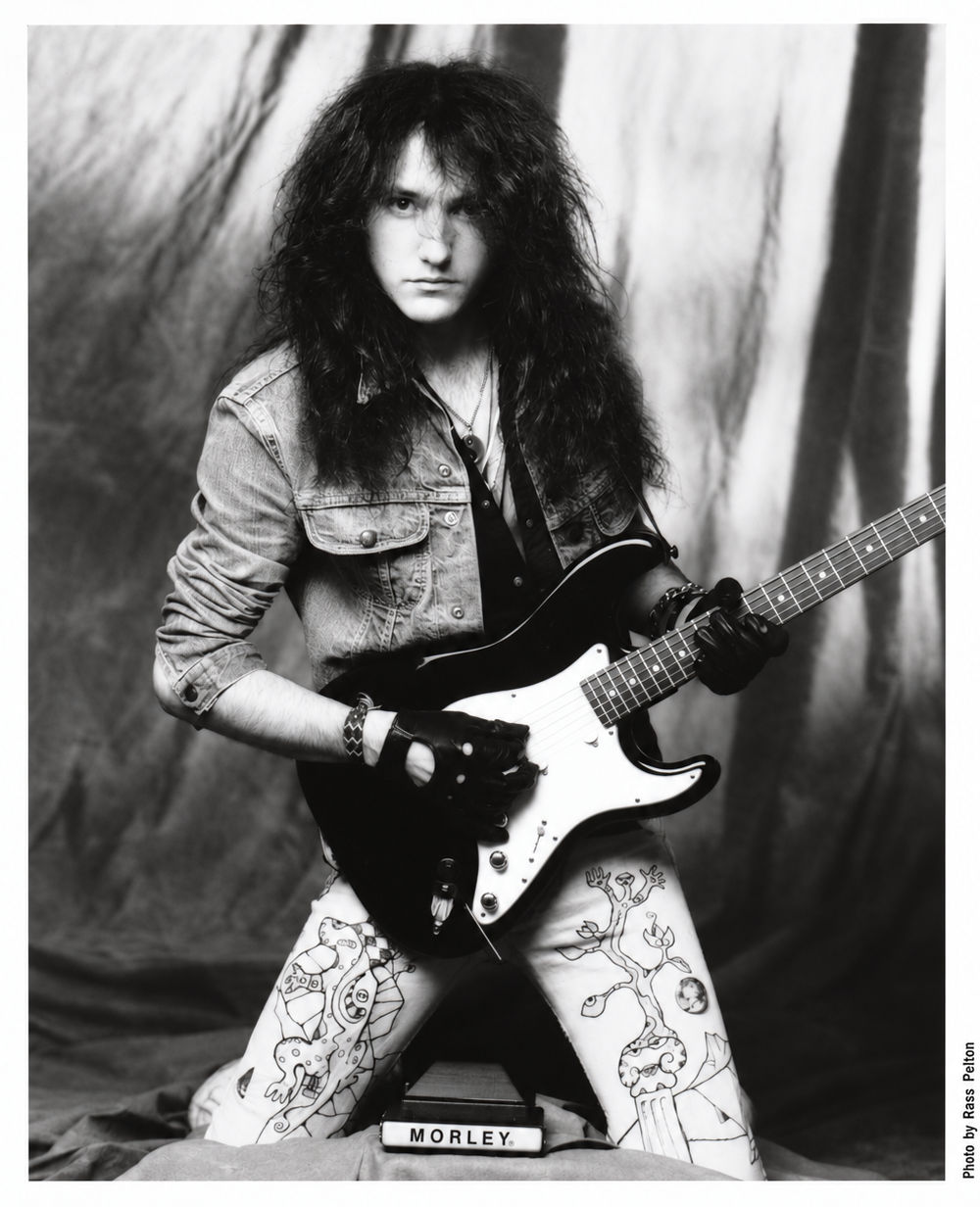
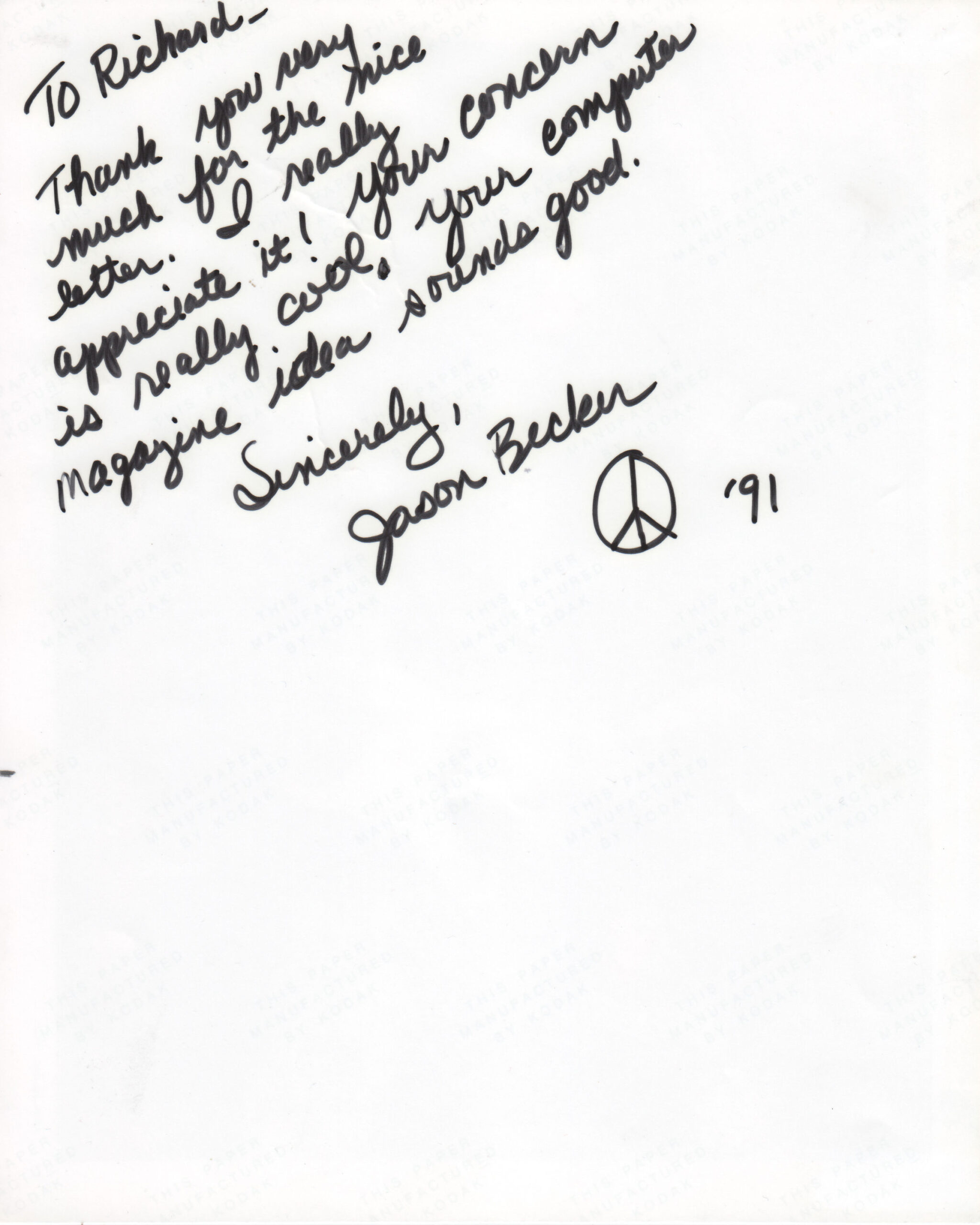 Needless to say, I am listening to his “Perpetual Burn” album while typing this. Tears are stinging in my eyes when thinking back of how the world could have been this man’s oyster. Despite ALS being a killing disease, however, extensive care by friends and family has assured that Jason’s still among us. In fact, there have been several benefit concerts under the “Jason Becker’s Not Dead Yet” monicker, and he has even recorded two more full-length albums (laboriously composed using his eyes and special software, then recorded by talented fellow musicians). “Perspective”, released in 1995, has a song (“End of the Beginning”) that is so hauntingly beautiful that I can’t even listen to it without tearing up. Yeah, I guess I am a soppy git.